
Many international businesses do have leads, but those leads end up in representatives’ personal WhatsApp accounts. The company cannot see conversations, quotation progress, follow-up timing or repeat-purchase opportunities. The problem is not insufficient WhatsApp usage but failing to turn relationships into company assets.
When growth stalls, exporters often assume they need more leads and invest in advertising, purchased enquiries, exhibitions, websites and content. Those channels matter. Yet our work with sales teams shows that the question is also where relationships end up after acquisition.
Customers commonly move to personal WhatsApp accounts. First replies, quotations, negotiation, samples and requirement discussions happen there.
Repeat purchases, referrals and after-sales often happen there too. WhatsApp is a real sales workspace, but the company does not truly retain customer assets when that workspace belongs entirely to an individual.
Customers can be in conversations without being in the company’s system
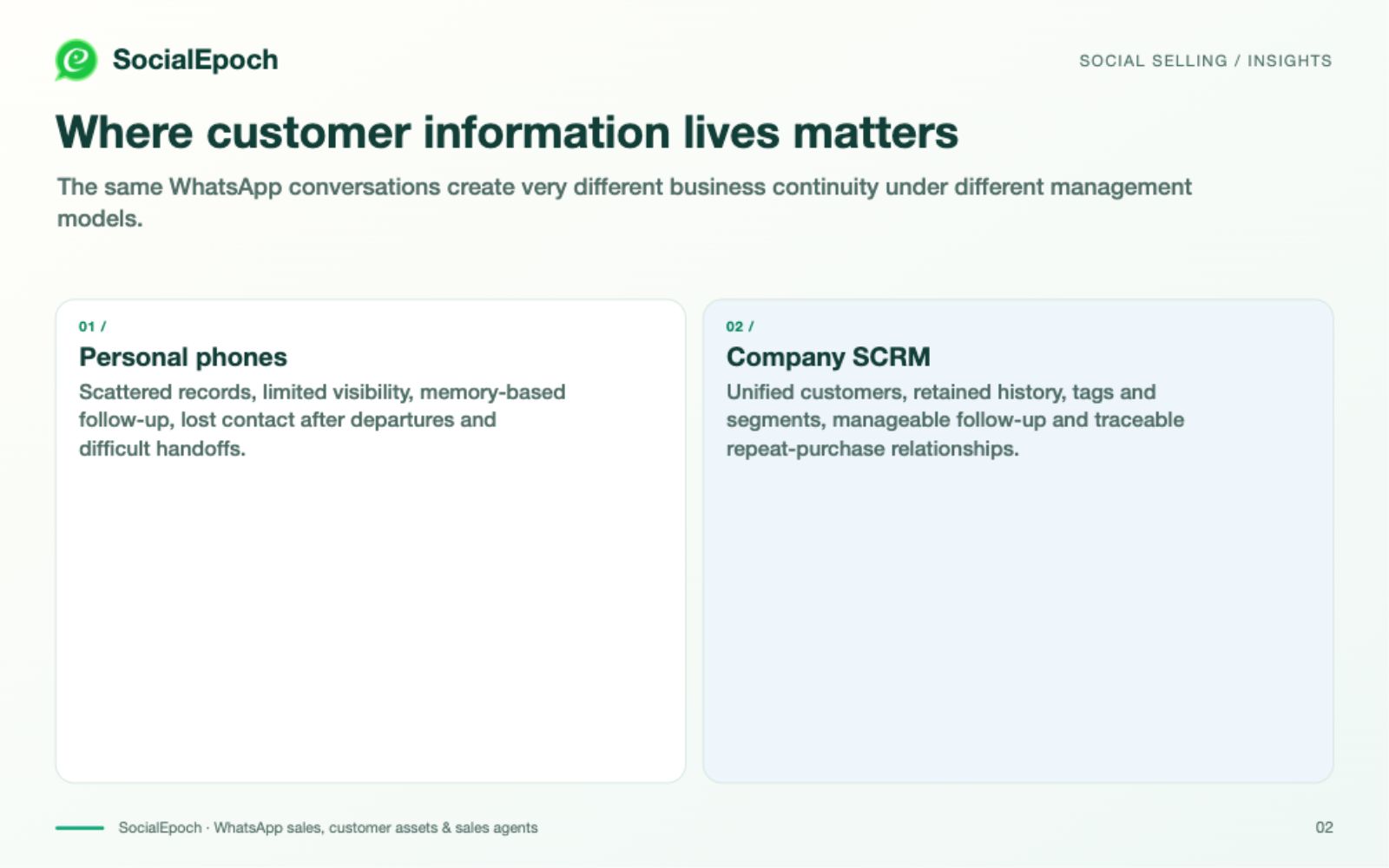
Owners often see representatives adding contacts without knowing their quality, or customers asking about prices without visibility into why the opportunity did not progress.
Repeat orders depend on memory; departures can cut off relationships; and the team struggles to compare effective messages, customer types or markets despite many conversations.
The company appears to have WhatsApp and a sales team, but assets remain scattered across phones, histories and personal habits instead of entering a shared system.
What looks like owned customer engagement may simply be customers dispersed across employees’ personal accounts.
A WhatsApp customer relationship is more than an added contact
WhatsApp’s value is the ability to build ongoing relationships with international customers. Personal phones and human memory alone cannot support that consistently.
A business needs a sales system: can customer records be retained centrally, and can conversation history be preserved?
Can customers be tagged and segmented by market? Can follow-up have reminders and cadence? Can managers see the team’s process?
Can new owners understand previous conversations quickly? Can AI assist translation, replies, qualification and next actions? These answers determine whether WhatsApp is merely a chat tool or a pool of company customer assets.
Build the missing WhatsApp sales infrastructure
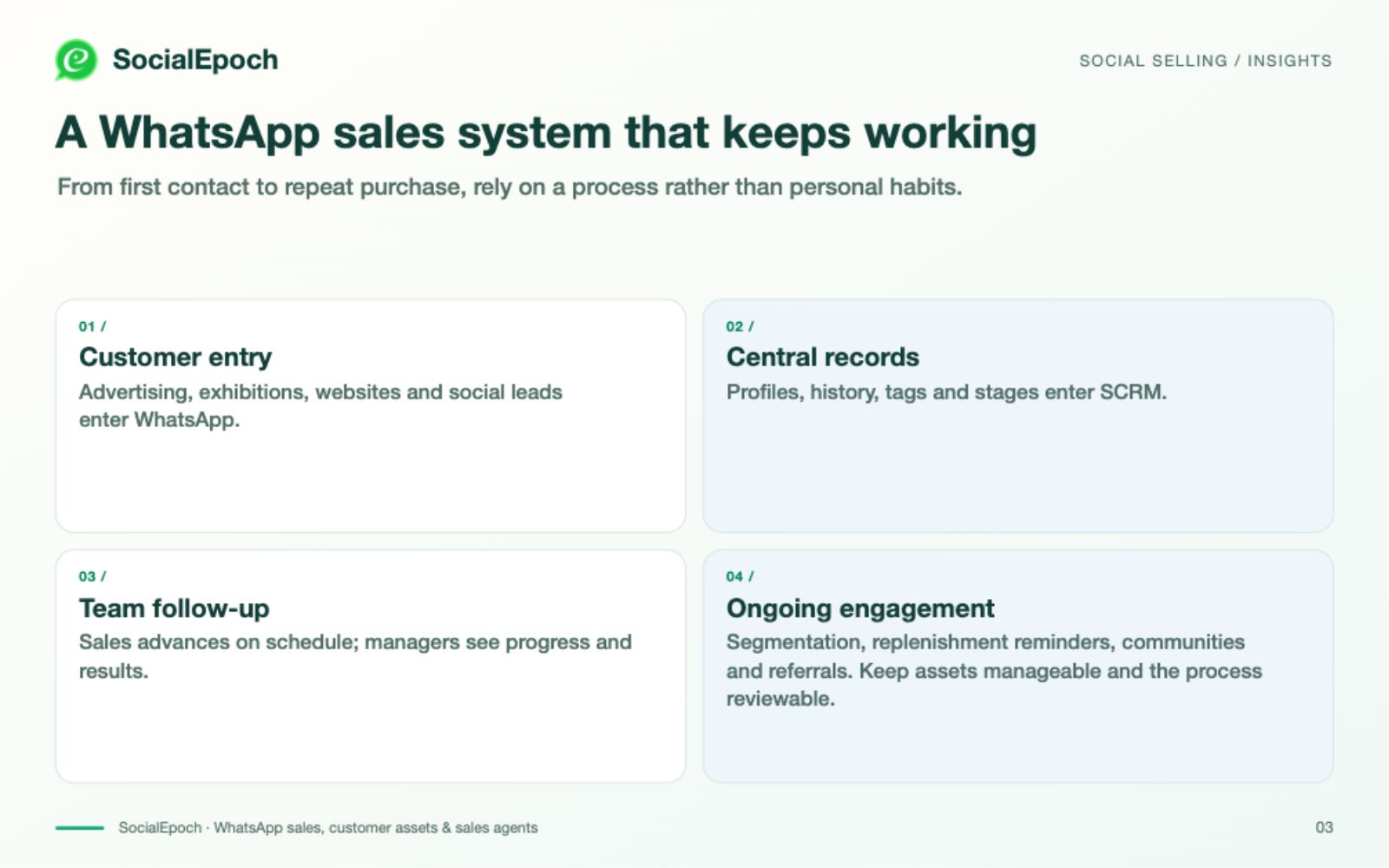
When teams are small, individual representatives may manage contacts and follow-up adequately. As markets, headcount and countries expand, that personal-tool approach becomes harder to sustain.
More customers can mean more fragmented management; more accounts can mean harder-to-manage risk; larger teams make standards less consistent.
Long sales cycles are also harder to review. The missing piece is sales infrastructure that supports the team over time—not simply registering more accounts. That is what SocialEpoch works on.
More than customer support: proactive sales and ongoing engagement
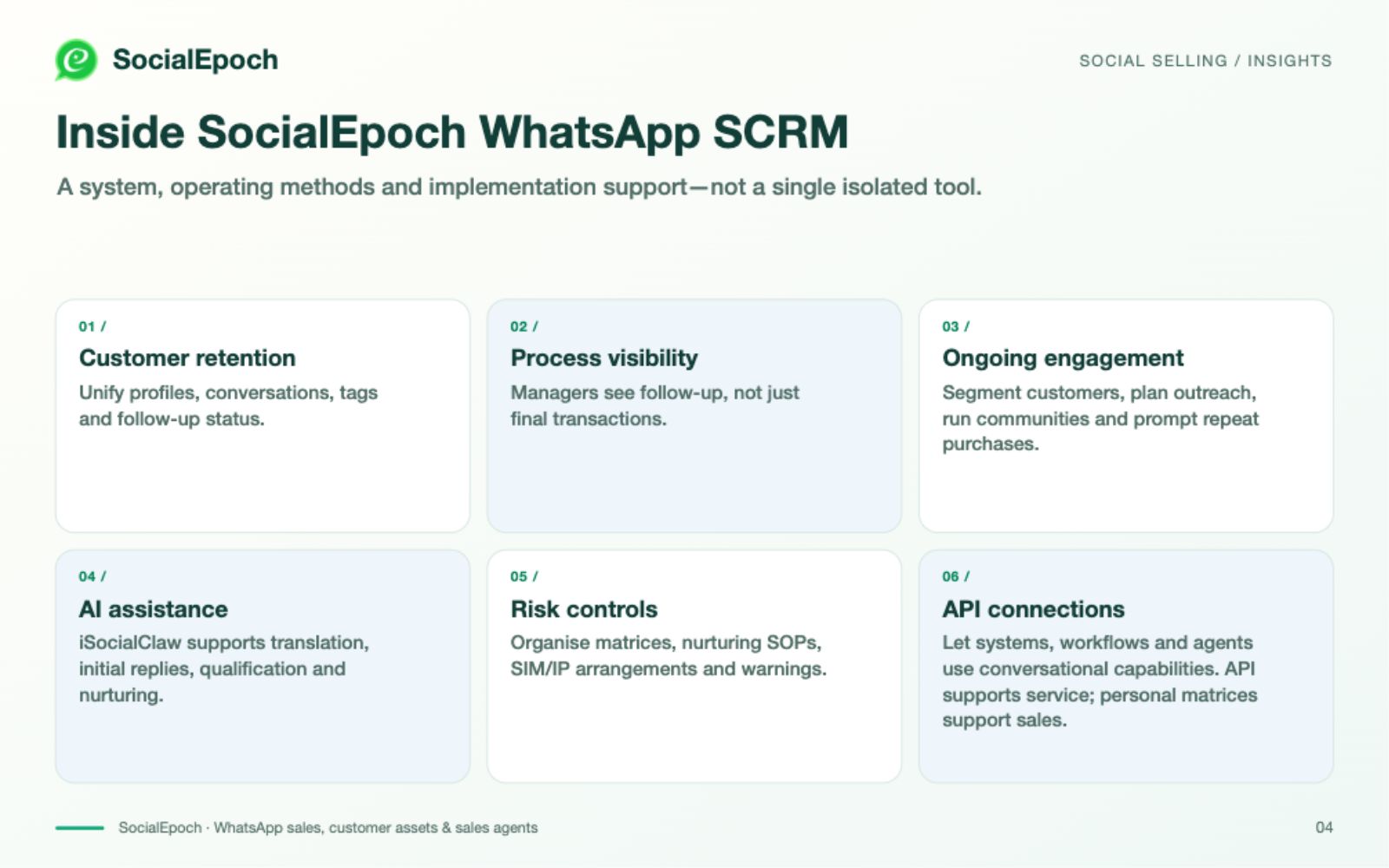
SocialEpoch provides proactive sales and customer-engagement systems built around personal WhatsApp account matrices. Its core WhatsApp SCRM product, SalesEpoch, is more than multiple logins or passive support.
The focus is helping international businesses manage account matrices and build a complete operating capability around their sales and engagement needs.
First, retain customers in company SCRM rather than personal accounts. Profiles, conversations, tags, stages and operating data can be collected centrally. Second, make the process visible.
Managers can see discussion progress, follow-up timeliness and priority customers, not just final transactions. Third, sustain engagement through tagging, segmentation, outreach, communities and repeat-purchase reminders, so relationships do not restart from zero each time.
Fourth, use AI assistance. Through iSocialClaw, SocialEpoch combines SCRM, conversational APIs and agents to assist translation, initial responses, qualification, reminders and nurturing, leaving salespeople more time for high-value work. Fifth, organise account matrices and risk controls.
Account stability and platform rules matter. SocialEpoch does not promise accounts will never be restricted. It systematises account matrices, nurturing SOPs, overseas SIM/IP arrangements, distribution of accounts, content cadence, warnings and customer workflows for more professional operation.
Business API for service; personal account matrices for proactive sales
Business API suits incoming support, order notices and after-sales. Export teams also need prospecting, ongoing follow-up, existing-customer engagement, groups and repeat purchases.
Personal account matrices can contribute to those scenarios. SocialEpoch views Business API as complementary rather than opposing it.
Support can use Business API while sales uses personal account matrices, letting the company benefit from both service and sales roles.
Ask whether the company retains relationships, not just how many contacts it has
Leads matter, but pursuing volume alone can create a cycle of paying for acquisition while losing customer relationships.
Ask whether customers enter the company’s system and whether sales processes can be managed and reviewed.
Can existing customers be engaged over time? Can relationships continue when staff change? Can WhatsApp conversation information become a company growth asset?
Addressing those questions turns WhatsApp into a durable base for proactive selling and engagement. SocialEpoch aims to turn personal-account customers into company relationships that can be managed, tracked, developed and revisited.
Want to review your WhatsApp sales workflow?
Contact the SocialEpoch assistant for a diagnostic discussion about whether customers are truly retained in your company system. WeChat: @SocialSelling888. Phone: +86 15601882491.
SocialEpoch provides proactive sales and ongoing engagement based on personal WhatsApp account matrices. SalesEpoch SCRM, conversational APIs and iSocialClaw agent design support prospecting, customer retention and more efficient follow-up.