
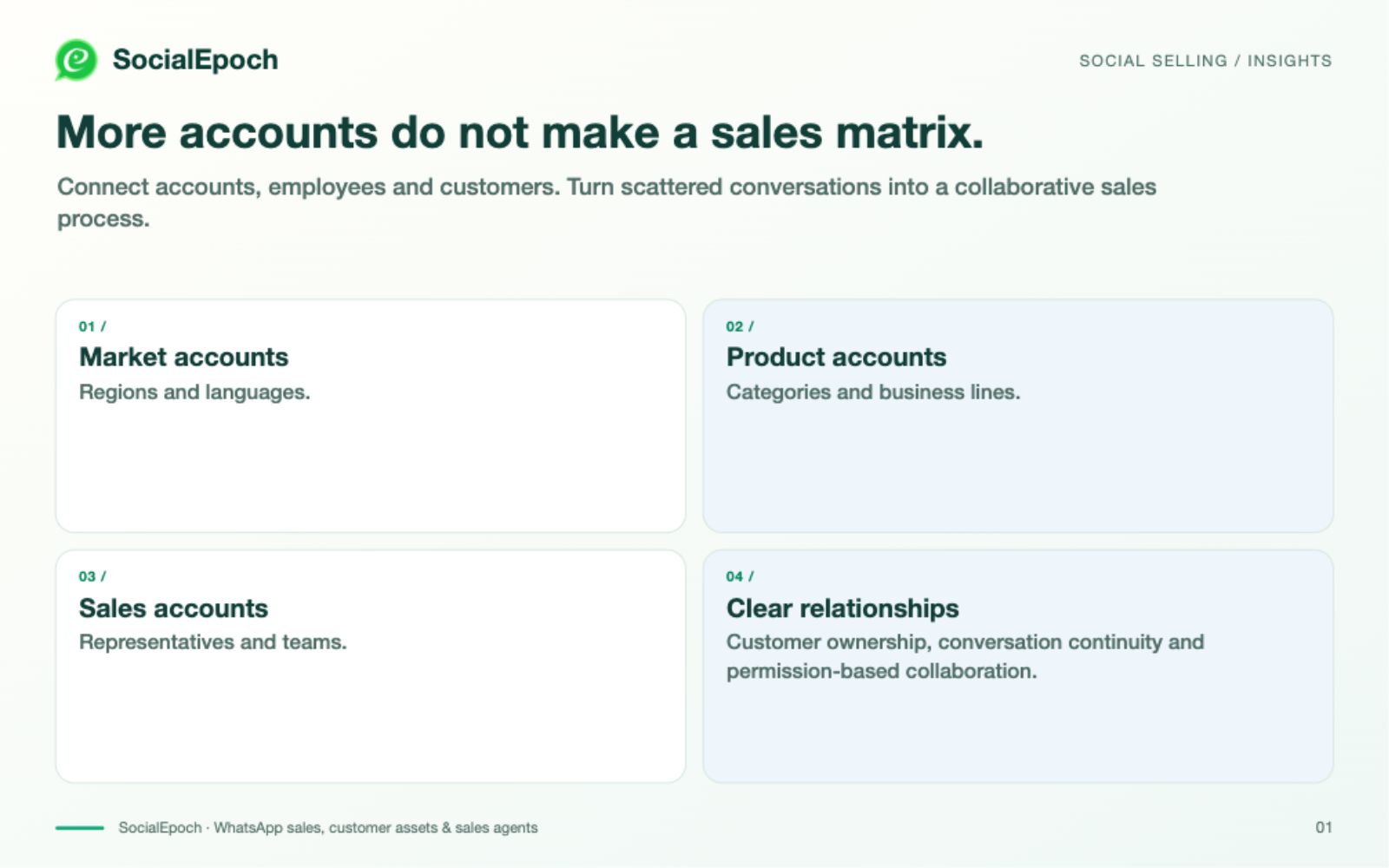
Many export businesses begin with one or two WhatsApp accounts. As markets, products and teams grow, some representatives cover Europe, others the Middle East; some serve existing customers, others develop distributors. More accounts create more touchpoints, but do not automatically create sales capability.
The same customer may be contacted repeatedly, history may stay on personal devices, and changes in account ownership can leave nobody sure who should follow up. Managers see outcomes but not the process. The missing piece is a way to organise accounts, employees, customers and sales workflows—not simply more logins.
Multiple accounts are a quantity; an account matrix is an organisational structure
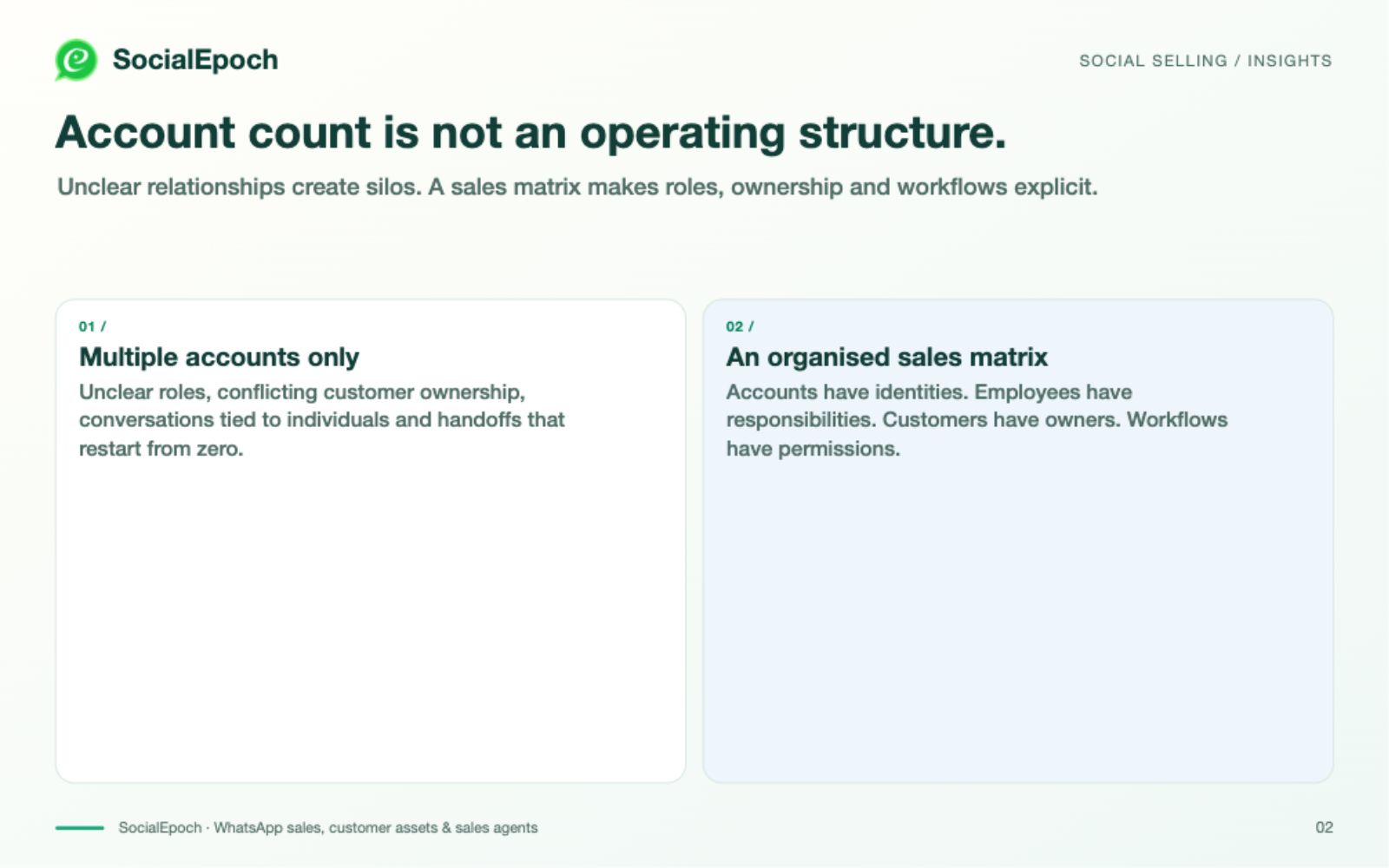
A genuine personal WhatsApp sales-account matrix must answer four questions: which market or product does the account represent, who handles daily communication, which customers belong to it, and how can the team view, collaborate and hand off within permissions?
Without those relationships, multiple accounts are disconnected entry points. SocialEpoch starts with structure before account count. Businesses can organise by country, language, category, brand or sales stage, combining market, product and representative accounts. Every account has a role, employees know their responsibilities and customers have an owner.
This connects customer touchpoints to team responsibilities. Prospecting, priority follow-up, partner management and after-sales collaboration need not crowd into one account, and duplicate outreach and conflicting information become easier to avoid.
Organise four layers of relationships
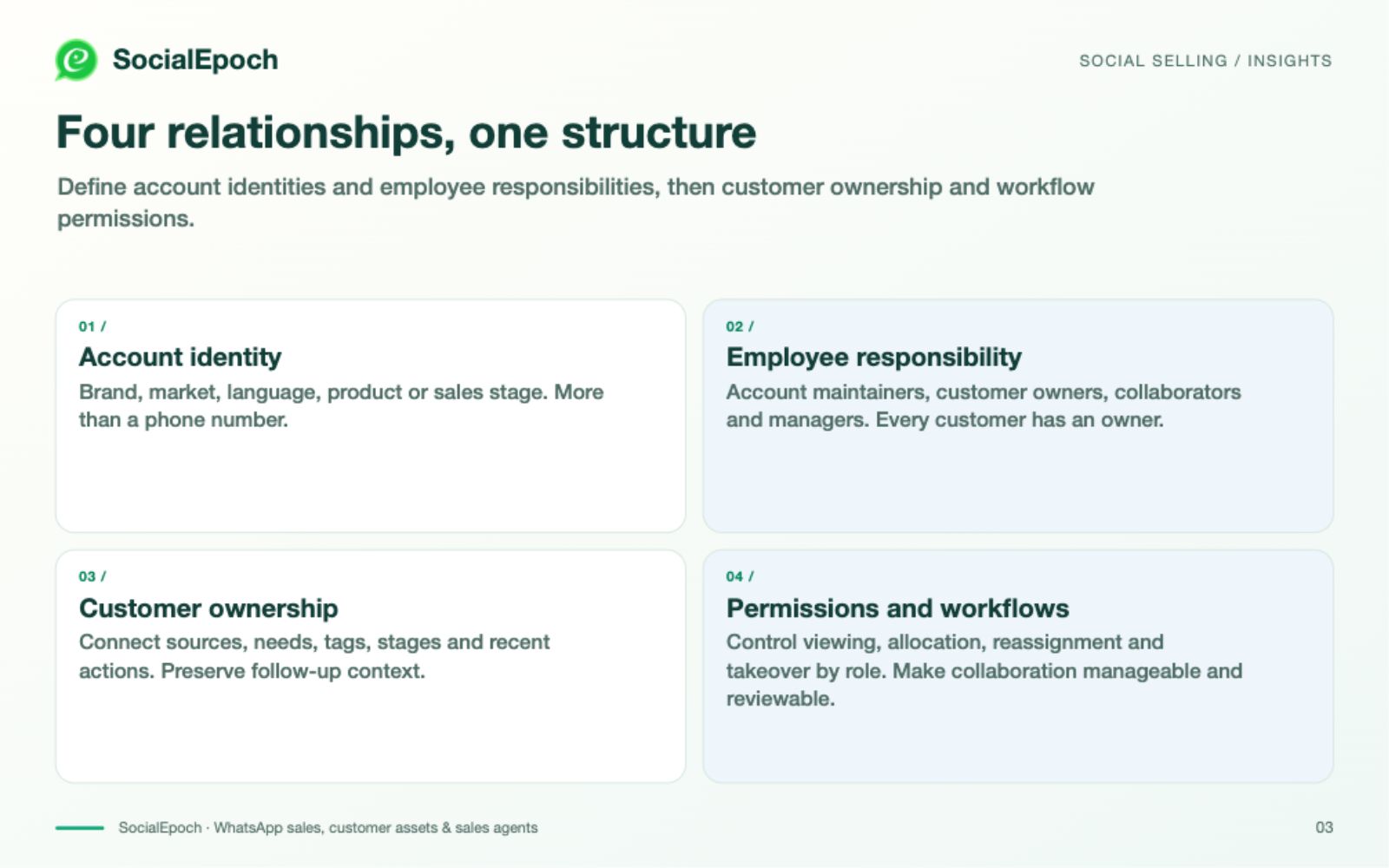
First, account identity: each account should represent a brand, market, language, product line or business role, rather than just a number.
Second, employee responsibilities: identify account maintainers, customer owners, collaborators and managers so visibility does not become everybody’s access but nobody’s responsibility.
Third, customer ownership: link sources, tags, needs, stages and recent actions to an owner for continuous follow-up.
Fourth, permissions and workflows: configure who can view conversations, allocate customers, change ownership, export information or take over communication according to role and business boundaries.
SalesEpoch carries these relationships. Connected accounts feed profiles, tags, history, tasks and sales states into WhatsApp SCRM. Managers see who owns the customer, the current conversation stage and next action—not merely whether an account is online. Salespeople can take over with context instead of repeating questions.
Connect account touchpoints to a customer-management loop
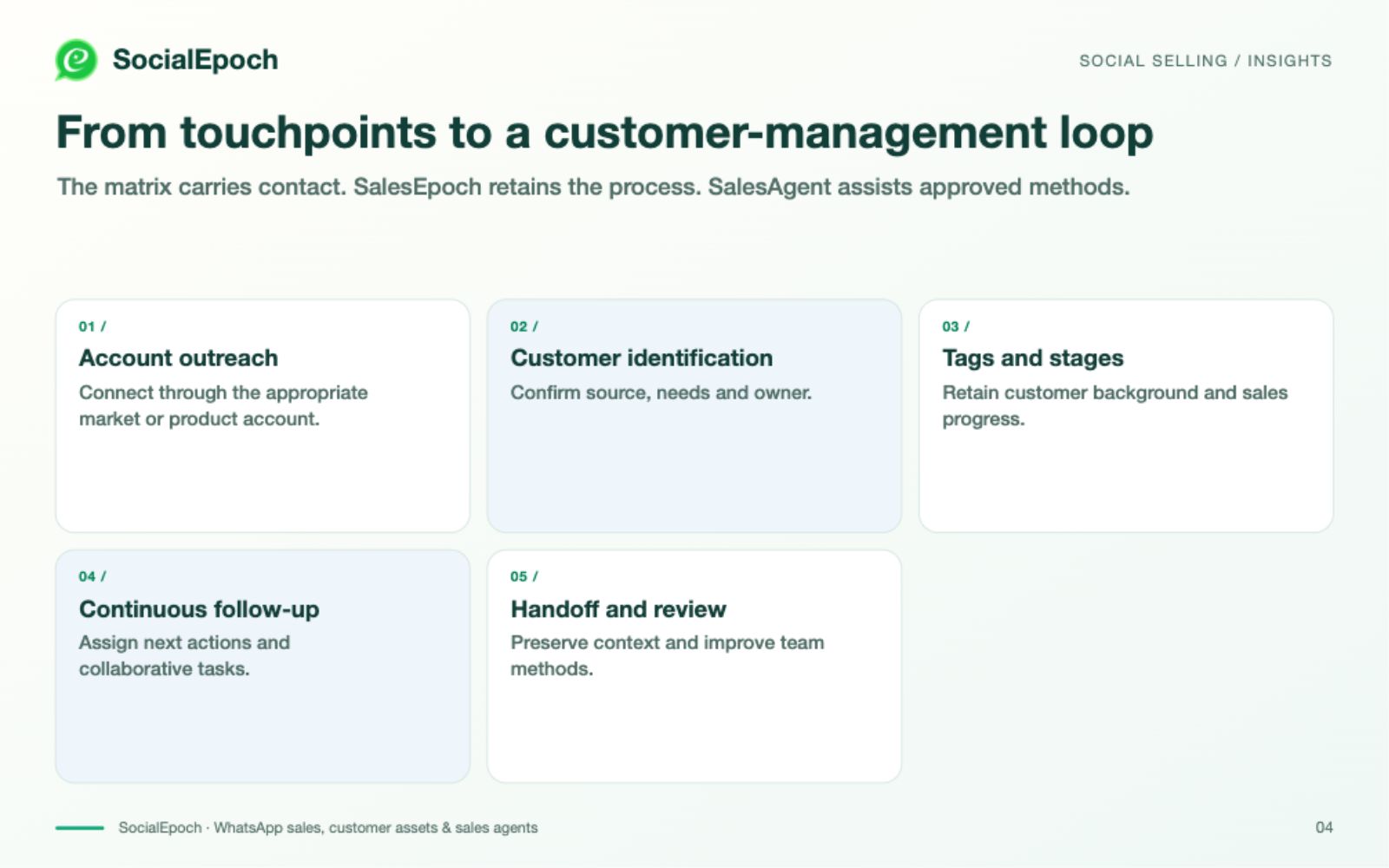
The matrix answers where conversations happen; SalesEpoch answers how the relationship stays with the company. Together they support outreach, identification, tags and stages, follow-up tasks, handoffs and review.
For example, a Middle East representative can record a distributor’s source, product categories, purchasing priorities and current stage. Product colleagues can supply technical information before the owner continues quotation follow-up. Authorised members can still understand the background if people or accounts change.
Within authorisation and human review, SalesAgent can summarise conversations, organise needs, prepare response ideas and suggest next actions. People retain responsibility for quotations, commitments, relationship judgments and exceptions. Touchpoints, customer records and approved methods have distinct roles.
Personal accounts and WhatsApp Business API can complement each other
Personal accounts suit proactive sales requiring sustained communication, judgment and relationships, such as B2B purchasing, distributor development, high-value products and regional distribution. Business API suits permission-based notifications, support, order updates and scalable service.
An enterprise can use API for standard service and a personal account matrix for deeper sales conversations. Allocate tasks by customer journey and observe platform rules, data permissions and local requirements. An account matrix is not indiscriminate bulk messaging and does not mean risk-free accounts.
Four steps toward a manageable sales matrix
- Inventory accounts and define each account’s market, product and role.
- Clarify employee and customer ownership, collaborators and handoff rules.
- Unify customers, conversations, tags, stages and tasks in SalesEpoch.
- Regularly review duplicate outreach, missed follow-up, ownership conflicts and process gaps.
Account quantity is not the end goal. SocialEpoch helps expanding international teams build sales infrastructure with clear roles, ownership, records and collaboration, so each real conversation becomes part of a relationship that can be managed over time.