
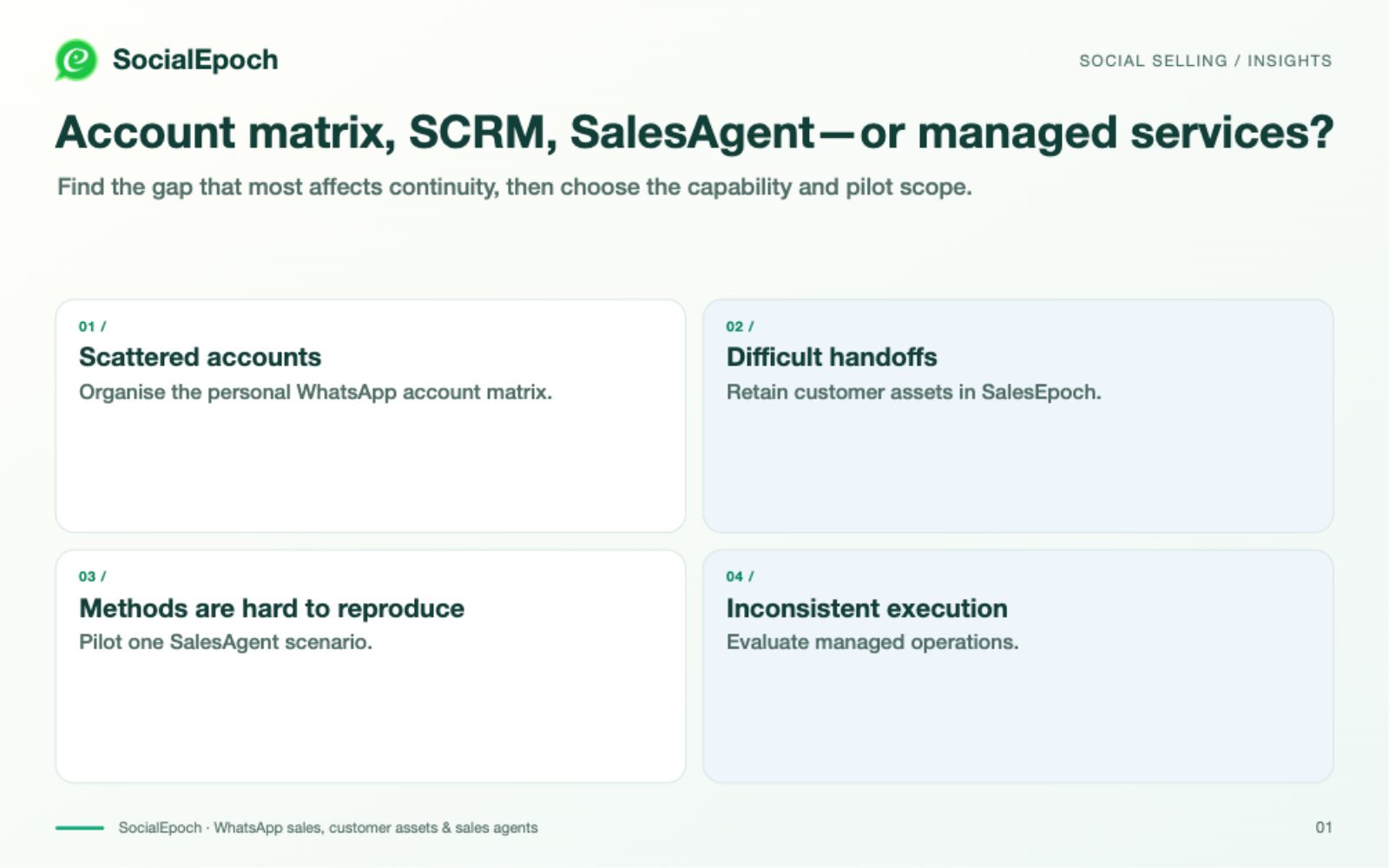
Businesses building a WhatsApp sales system face many options at once: multiple accounts, SCRM, AI sales agents, managed engagement, Business API and system integrations. More features can make the starting point harder to identify.
Begin with the gap that most harms continuity, rather than comparing which product has the most features. Disorganised accounts, difficult handoffs, dependence on individual expertise and inconsistent execution are different problems needing different starting points.
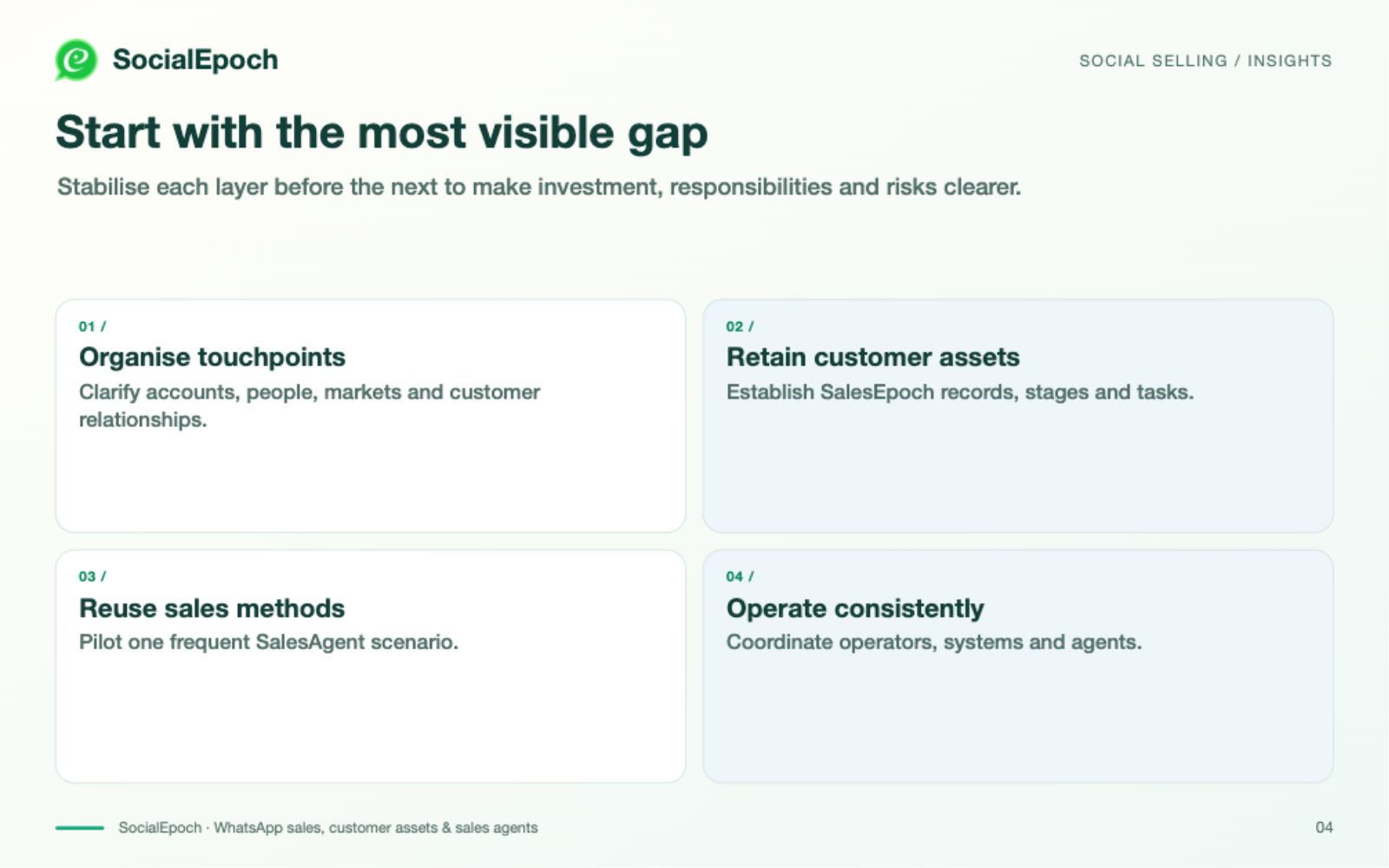
SocialEpoch’s four layers form a progression: personal account matrices organise touchpoints, SalesEpoch retains customer assets, SalesAgent captures skills and managed operations supports execution. They need not be deployed together.
Scattered accounts: organise the personal account matrix first
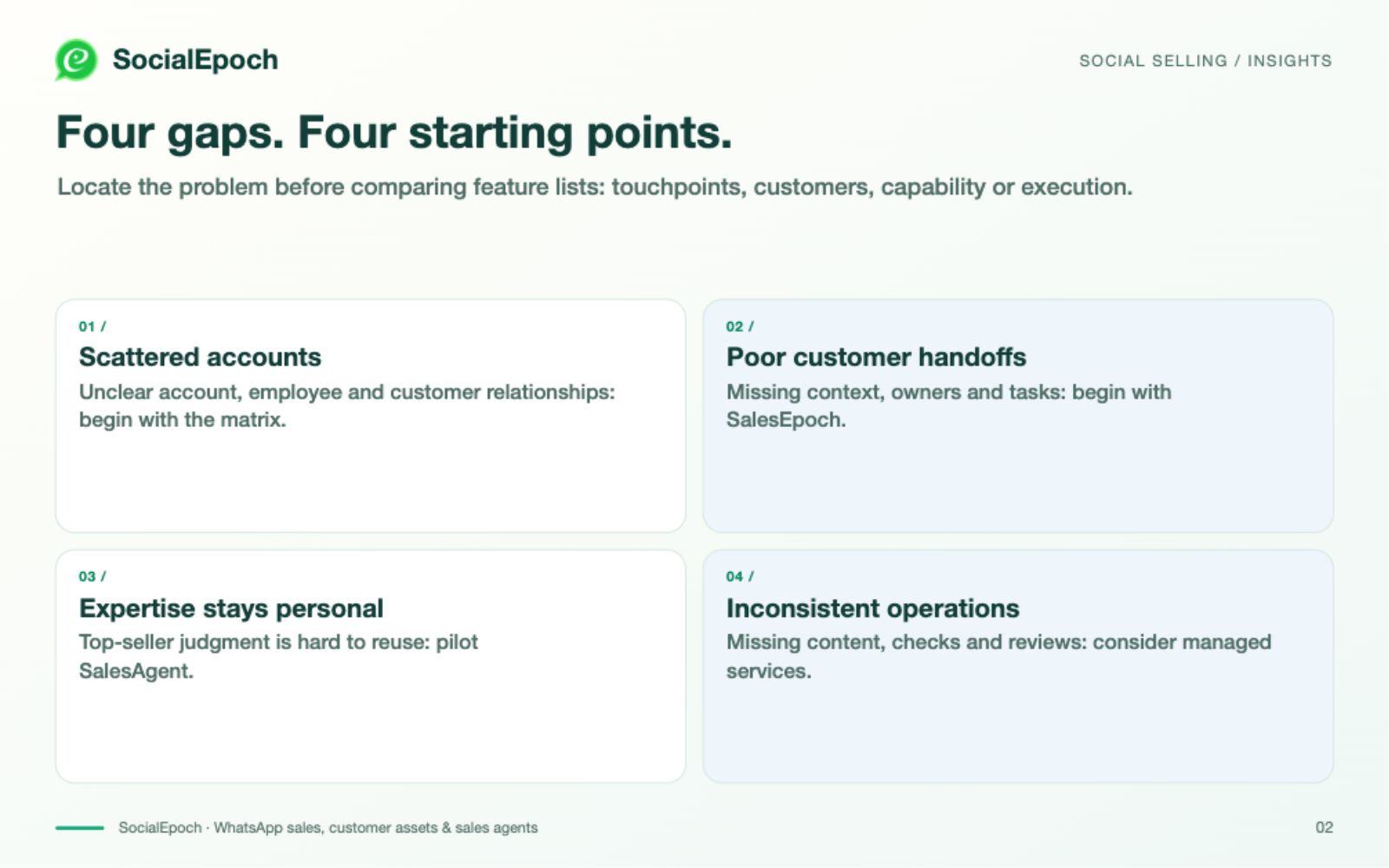
When representatives independently use WhatsApp, clarify which employee uses each account, its market or product, customer ownership and continuity after changes before introducing AI replies.
Personal account matrices support proactive sales, sustained engagement, deeper conversations and relationship building. Business API supports permission-based notifications, support and official messaging. They can complement one another, within platform, local-market and company-authorisation boundaries.
An organised matrix creates a basis for permissions, responsibilities and handoffs, reducing dependence on personal devices.
Difficult handoffs: retain customer assets in SalesEpoch first
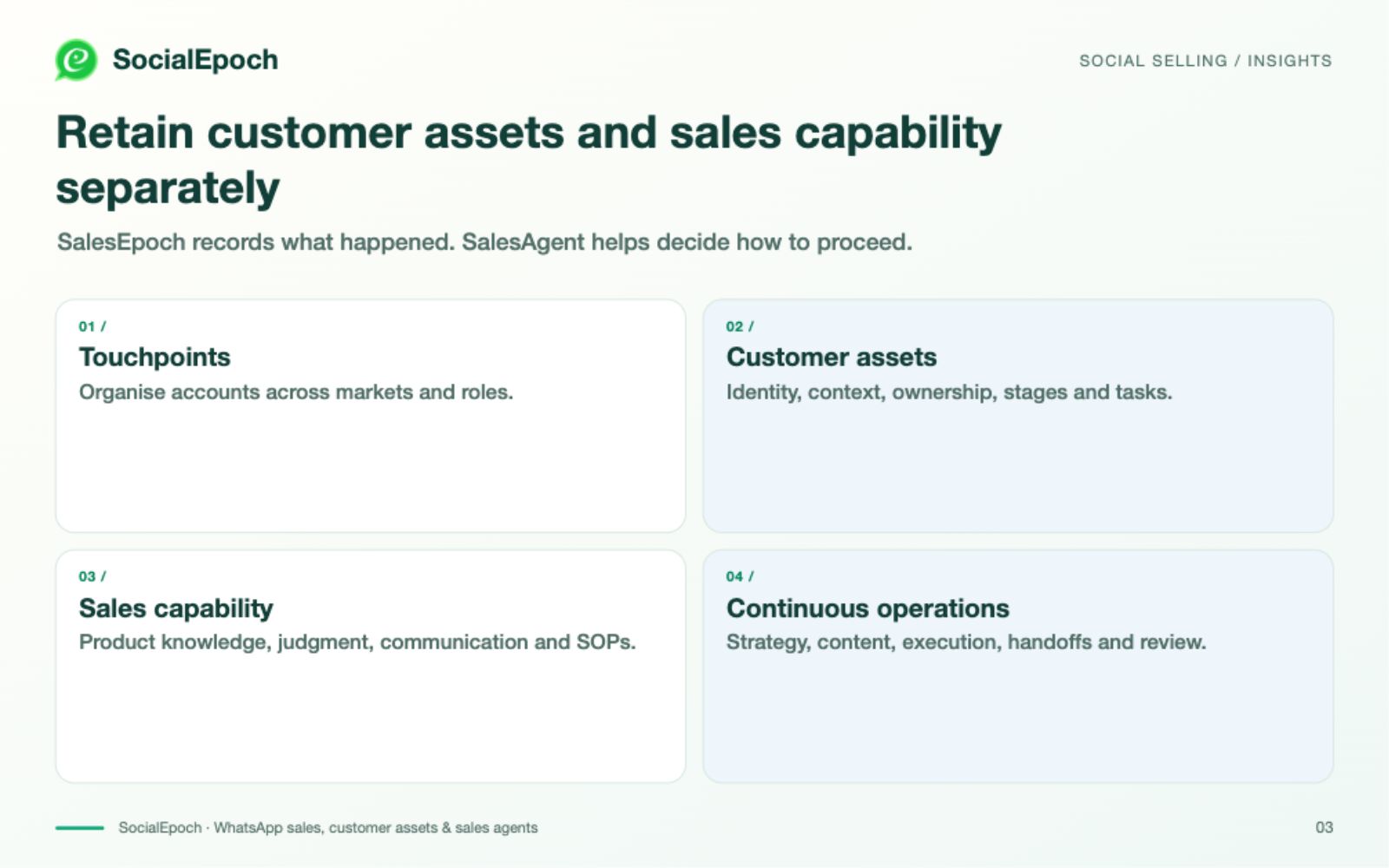
Connected accounts do not automatically create customer assets. Names and numbers alone omit sources, context, stages, owners and next tasks, leaving new representatives to start over.
SalesEpoch addresses identity, context, ownership, stage-related tasks, permissions and review. Scattered conversations become a process authorised colleagues can understand and continue.
This step suits growing customer bases, collaborative teams, frequent handoffs or managers without follow-up visibility. Clarify the customer process before adding complex automation.
Dependence on top sellers: pilot a SalesAgent scenario
Once customer assets are clear, differences in judgment and progress reveal another question: has the company retained its best methods as well as its customers?
SalesAgent captures knowledge, assessment criteria, scripts, SOPs and boundaries, using context to prepare replies, summarise needs and suggest actions. It does not guarantee deals. People retain prices, negotiation, relationship judgment and exceptions.
Start with frequent, repetitive scenarios with clear boundaries: new enquiries, pre-quote questions, common responses, re-engagement or human-handoff alerts. Validate one before expanding.
Inconsistent execution: consider managed operations
Some companies have software and customers but nobody continuously designing workflows, maintaining content, checking tasks, improving agents and reviewing performance. More features may not address that gap; an operating role may be needed.
SocialEpoch combines operators, account matrices, SalesEpoch and SalesAgent around an industry and customer journey. The business supplies accurate products, prices, fulfilment and authority; the service team designs structures, executes content, configures systems and reviews processes. Key commercial decisions stay with the business.
Four questions to identify your starting point
- Are relationships between accounts, employees and customers clear? If not, organise the matrix.
- Can customer identity, context, ownership and tasks be handed off? If not, establish SalesEpoch workflows.
- Do mature sales methods exist but remain hard to reproduce? Pilot one SalesAgent scenario.
- Are systems and methods in place but execution and review inconsistent? Evaluate managed operations.
Existing CRM, ERP, order and after-sales systems can be connected gradually, provided responsibilities and data boundaries are clear.
A WhatsApp sales solution is not better because it includes more purchases. Repair the most consequential continuity gap, stabilise each layer and then expand. That makes investment, responsibility, risk and real change clearer as conversations develop into a sustainable SocialSelling system.